Limited rights licenses
Each owner grants a temporary, project-specific license for selected characters, mythology, numbers, symbols, archive footage or names. Ownership of the original series never changes.
Disney, Amazon MGM and Paramount do not need to own one another—or transfer their crown-jewel IP—to create a limited shared event.
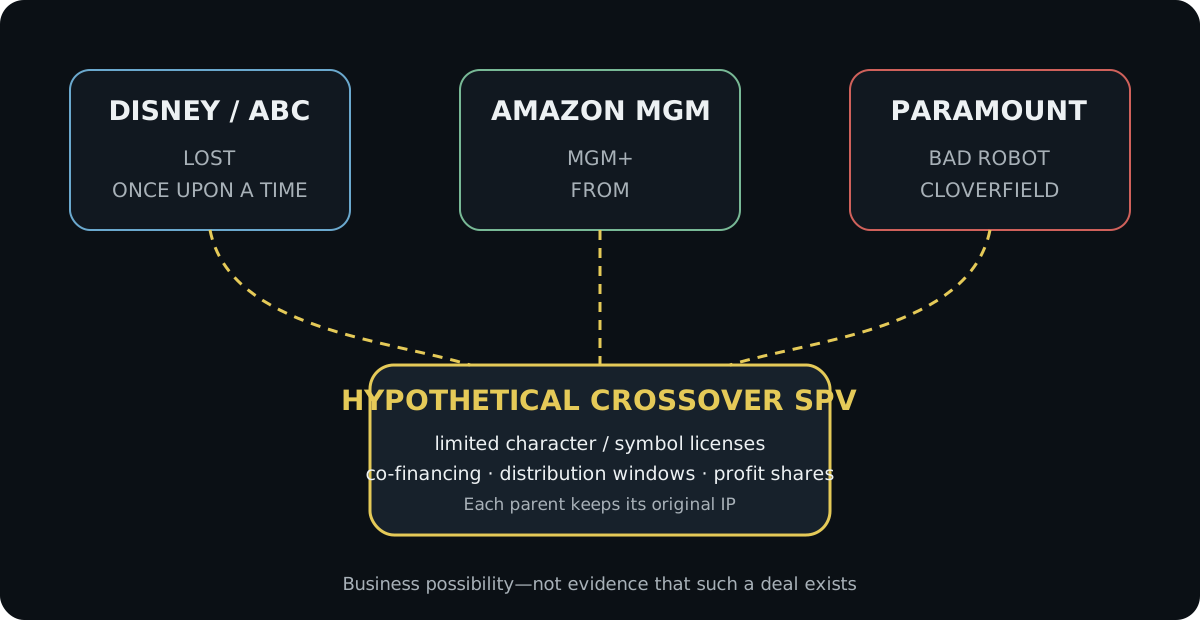
| Corporate home | Relevant property | Verified context |
|---|---|---|
| Disney / ABC | LOST and Once Upon a Time | Disney’s own history records the Capital Cities/ABC merger; both series are listed on Disney’s platform.[22][23][24] |
| Amazon MGM | FROM / MGM+ | Amazon acquired MGM in an announced $8.45 billion transaction, and EPIX was relaunched as Amazon-owned MGM+.[25][26][27] |
| Paramount / Bad Robot | Cloverfield | The next Cloverfield project is reported at Paramount with Bad Robot and J.J. Abrams.[28][29] |
Each owner grants a temporary, project-specific license for selected characters, mythology, numbers, symbols, archive footage or names. Ownership of the original series never changes.
The companies create a new entity or agreement for only the crossover. Co-production agreements commonly define who contributes rights, capital and services and who controls development, production, financing and distribution.[38]
Bad Robot has a documented history of working through broad studio agreements and now has a reported non-exclusive first-look pact with Warner Bros. A non-exclusive production company can bring a project to different partners, subject to its contracts and the underlying IP owners’ approval.[36][37]
One studio could handle theatrical distribution, another domestic streaming and another international or later windows. The deal can divide markets without dividing the underlying canon.
The joint agreement can allocate box office, subscriptions, advertising, home video, licensing, merchandise, games and ARG income through negotiated percentages, fees and backend participation. Joint-venture guidance specifically emphasizes defining IP ownership and profit shares across revenue streams.[39]
Each owner can retain veto or approval rights over its characters and mythology. The project can establish a shared story committee without granting permanent control of LOST, FROM or Cloverfield to another studio.
Amazon MGM’s 2025 James Bond joint venture is a concrete example of a franchise in which distribution rights and future creative control were separately held and then reorganized by agreement.[40]
That does not prove a Story Engine deal. It proves the business mechanism is ordinary enough to be possible.
Amazon itself described MGM’s deep catalog as a “treasure trove of IP” it planned to reimagine and develop, demonstrating the broader corporate appetite for library expansion.[25]
Shared personnel, deliberate Easter eggs, production methods and repeated structures.
A co-produced special, game, ARG or limited series built through temporary cross-licenses.
A pre-existing three-studio agreement connecting all four properties has not been publicly documented.
The studios could share rights and profit for one project without sharing permanent ownership. Possible is not the same thing as proven—but the legal obstacle is negotiable, not impossible.