The Drawings are visual constants
Across these worlds, a picture can hold information that memory, chronology, language or identity cannot safely preserve.
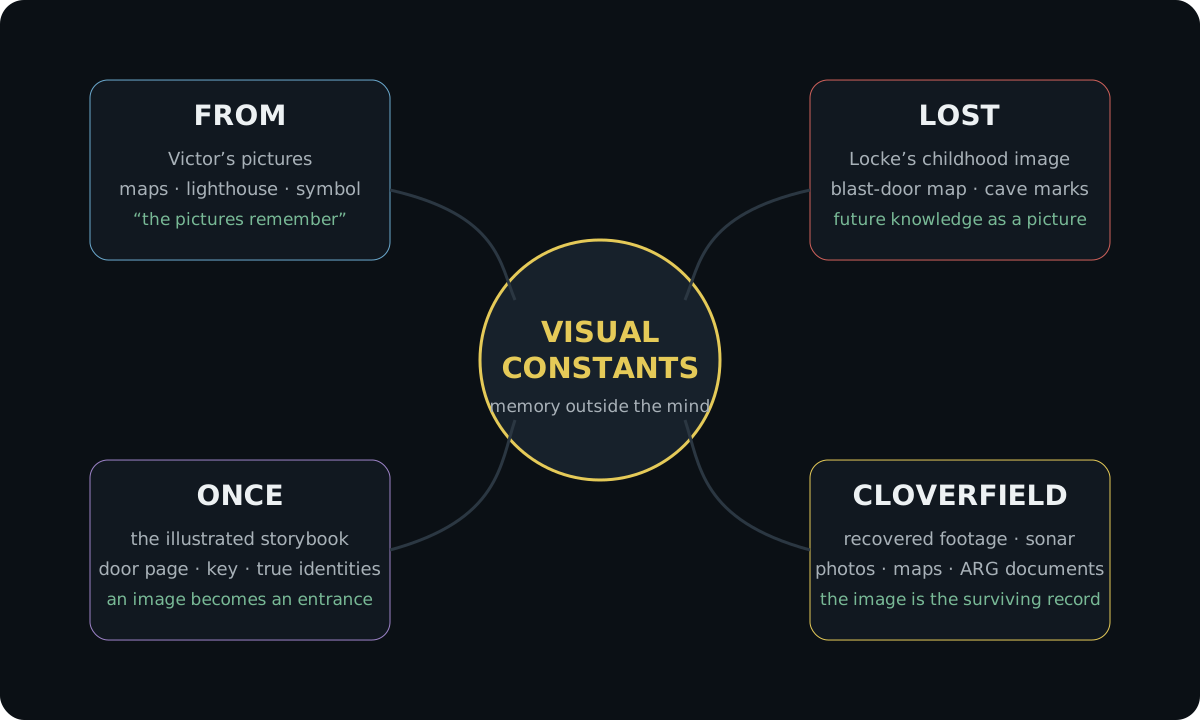
FROM: the pictures remember
Victor’s drawings are not childhood decoration. They document arrivals, bodies, maps, the Boy in White, the lighthouse and events Victor later suppresses or mistakes for dreams. The show explicitly gives them an external-memory function: even if the person forgets, the picture remembers.[41][42]
Jade’s compulsive reproduction of the symbol and Christopher’s earlier journal create a second visual archive: the same mark can cross people and cycles before its meaning is understood.[49]
LOST: the image arrives before conscious knowledge
Young Locke draws a figure beneath a dark mass that Richard interprets as evidence of an Island connection. The image appears before Locke’s adult encounter with the Smoke Monster, making it look like memory or destiny arriving out of order.[12][13]
The Swan blast-door map performs the same work at a larger scale. It is a hand-drawn record hidden in ultraviolet light, layered with stations, equations, warnings and knowledge accumulated by people who may not have survived to explain it.[10][11]
Once Upon a Time: an illustration becomes a door
Henry’s book contains suppressed biographies and true identities. More radically, the illustration of a door is not merely a representation: it contains the Author and can be unlocked by a physical key. The image is both archive and portal.[43][44]
Cloverfield: evidence media replaces the storybook
The first film is framed as recovered government footage. The larger ARG surrounds it with photos, maps, fake corporate sites, news reports, sonar material and documents that preserve a story the feature film never directly tells.[33][34]
Cloverfield therefore uses a modern surveillance-and-archive version of the same device. Victor has crayon drawings; Dharma has a black-light map; Henry has an illustrated book; Tagruato has a corporate evidence trail.
The cross-show drawing board
| Visual object | What it knows | Story Engine function | Confidence |
|---|---|---|---|
| Victor’s drawings | Events and places that he forgets or represses. | Memory stored outside the mind. | Textual function[41][42] |
| Locke’s childhood drawing | An apparent image of the Smoke Monster before adult experience. | Future knowledge leaking backward. | Strong parallel[12][13] |
| Swan blast-door map | Stations, equations and warnings hidden from ordinary sight. | A survivor-built map of the unseen system. | Canonical object[10][11] |
| Henry’s door illustration | The Author’s hidden location. | An image that is also a traversable reality. | Canonical object[43][44] |
| Cloverfield ARG images | Corporate activity and a catastrophe outside the film’s viewpoint. | Distributed memory across media. | Transmedia method[33][34] |
Drawings that appear to point across shows
The theory author has also identified visual resemblances among FROM’s drawings and imagery in the other properties: dark masses resembling LOST’s Smoke Monster, lighthouse and tree diagrams, enclosed or globe-like towns, repeated child figures and maps whose meaning is only visible when several pieces are combined.
Our visual-constant theory
- The Story Engine changes or suppresses human memory.
- Images exist partly outside that interference.
- Children and visually driven characters record knowledge before they can explain it.
- Later characters mistake the archive for fantasy, art or nonsense.
- When several images are ordered correctly, they reconstruct the original story.
A constant does not have to be a person. It can be a picture that remains the same while the people, timelines and identities around it are rewritten.