42 · 23 · 16 · 15 · 8 · 4
The six values are read in reverse order—the simplest possible mirror of the complete code.
LOST taught viewers that a code can appear directly, in clusters, inside dates, on doors, as equations and in the background. Once confirmed that the code could migrate into another show. FROM may be teaching us to read it backward.
4 + 8 + 15 + 16 + 23 + 42 = 108
In LOST, the six values recur throughout the story, correspond to final candidates and serve as coefficients in the Valenzetti mythology. The Swan countdown is 108 minutes, making 108 both a practical deadline and the total of the complete sequence.[8][9]
The show trained its audience to combine and transform information. The numbers appeared as a complete transmission, individual candidate numbers, Flight 815, clock values, addresses, prices and even equations on the blast-door map. That matters because a hidden code does not have to arrive as six neat integers in one row.[8][10][11][18]
Storybrooke’s clock begins frozen at 8:15, moves to 8:16 and is later shown at 8:23. Emma receives room 4. Regina’s address is 108, and a hospital sign also uses 108. The effect is a clock literally walking through the LOST sequence while the show introduces a town trapped in artificial time.[19][20][21]
The theory author’s central observation is that FROM places relevant values on doors, screens, books, magazines and environmental objects, but often disguises them through reversal or addition rather than displaying the sequence in LOST order.
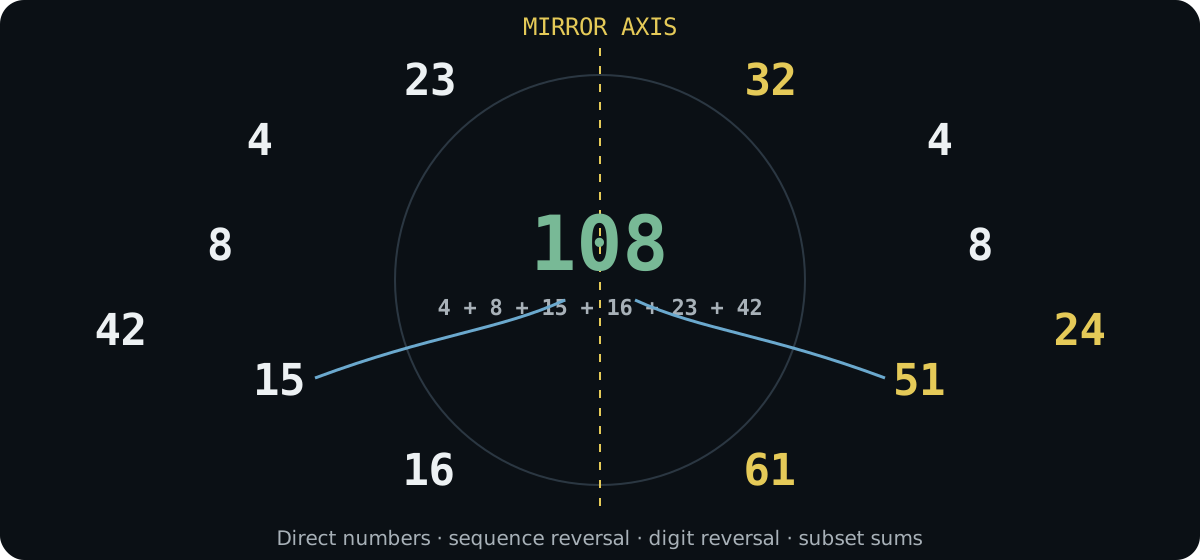
The six values are read in reverse order—the simplest possible mirror of the complete code.
15 becomes 51, 16 becomes 61, 23 becomes 32 and 42 becomes 24.
8 + 15 = 23
4 + 15 + 23 = 42
8 + 16 = 24 ← digit mirror of 42
4 + 8 + 16 + 23 = 51 ← digit mirror of 15
4 + 15 + 42 = 61 ← digit mirror of 16
LOST’s lighthouse uses numbered degrees and literal mirrors to observe candidate lives; FROM has its own lighthouse and a heavily scrutinized wall of numbers.[8][45][48]
Our interpretation is that the reversed code may mark a world viewed from the other side of the same mechanism: cause and effect reversed, past experienced as story, people remembering lives they have not consciously lived, and exits that require moving toward the origin.
| Date and time | Confirmed event | Why it matters |
|---|---|---|
| September 22, 2004 8:00 p.m. ET | ABC broadcasts LOST “Pilot, Part 1.”[51][55] | The beginning of the television mythology. |
| September 22, 2024 3:00 a.m. ET streaming 9:00 p.m. ET/PT linear | FROM Season 3 premieres on LOST’s exact twentieth anniversary.[14][15][16][52][53] | The anniversary-day alignment is confirmed even though creator intent remains unconfirmed. |
| April 8, 2015 16:23:42 | LOST Numbers Day reaches the complete date-time alignment: 4/8/15 16:23:42.[17][18][54] | The real calendar and clock become 4 · 8 · 15 · 16 · 23 · 42. |
The public web does not yet provide a reliable, episode-by-episode inventory of every Season 4 door, display, book and magazine. Rather than invent timecodes, the site separates confirmed dates and known lighthouse imagery from the theory author’s frame-level observations.
| Placement | Observation | Status |
|---|---|---|
| S3E1 release date | 09/22/2024 matches LOST’s 20th premiere anniversary. | Confirmed[14][15][16] |
| Lighthouse / dream wall | Multiple numbers are built into FROM’s recurring lighthouse imagery and have inspired date, coordinate and cycle theories. | Frame analysis[45][48] |
| Season 4 screens / displays | Viewer reports connect displayed values back to earlier lighthouse numbers and repeating chapters. | Needs official confirmation |
| Doors, books and magazines | The theory author reports direct core values, digit reversals and numbers that resolve through addition. | Needs episode/timecode captures |
| Other fan systems | FROM viewers independently add room, radio, family and tarot values, showing that the production consistently invites numeric decoding even when interpretations differ. | Fan analysis[46] |
Enter the digits you see in a frame. The tool checks direct core values, digit mirrors, the full 108 sum and simple subset sums. It runs entirely in the browser.
Use this local tool while rewatching. Exact episode and timecode evidence will make the public argument much stronger than a list of remembered sightings.
Cloverfield’s ARG unquestionably uses dates, corporate records, sonar imagery, coordinates and coded documents.[33][34]
However, this research did not verify a creator-confirmed appearance of the entire 4–8–15–16–23–42 sequence across the released Cloverfield films. The Cloverfield connection is currently strongest through Bad Robot, ARG methodology and dimensional mechanics—not through a proven six-number crossover.